
“On that leaf,” Wayne said. “Just above the water.”
Wayne’s Wander · Short story
A Leaf for the Sting
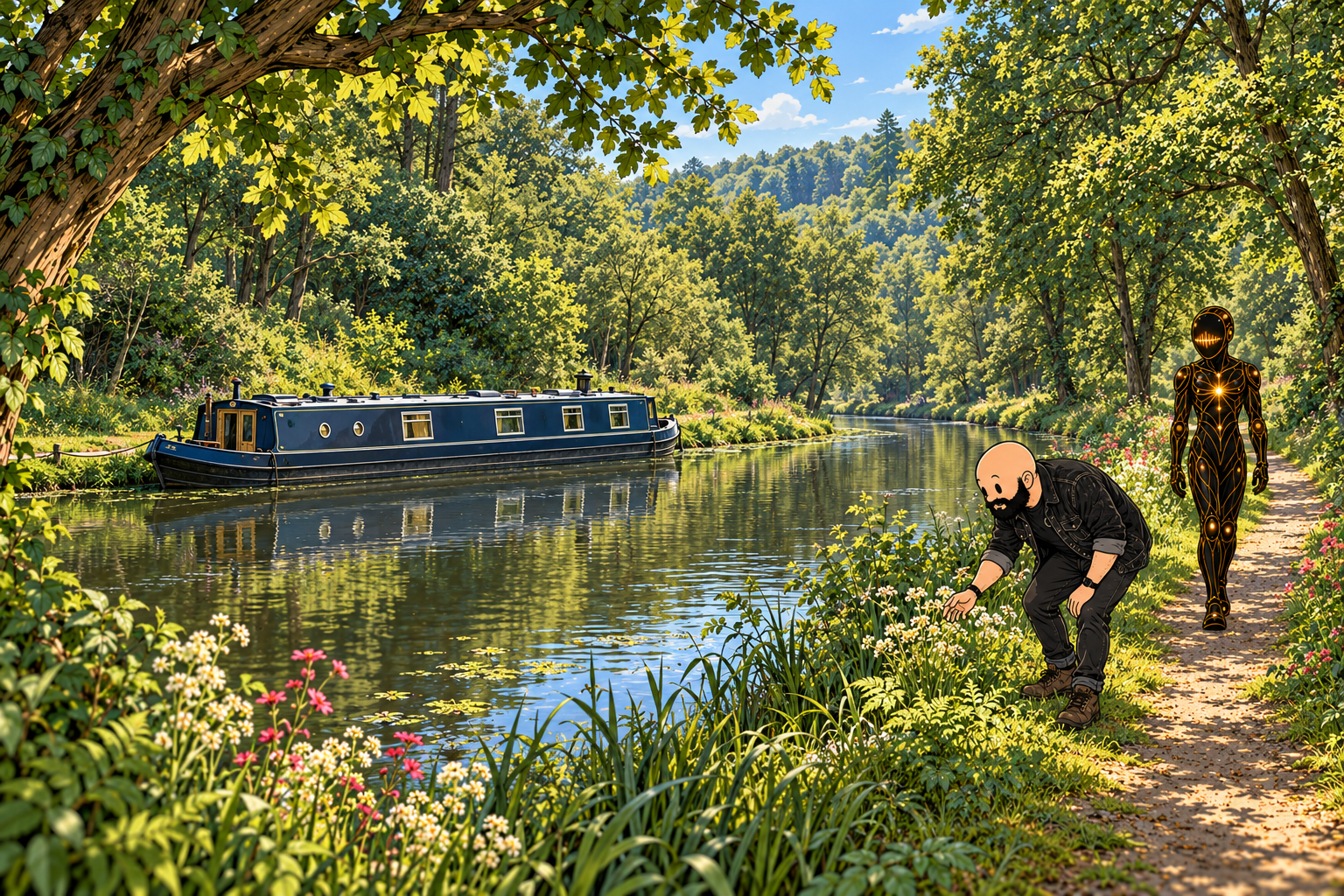
Orion stopped beside him.
The damselfly had settled with its wings folded along its body. A moment before, it had been easy to follow: a blue glint, four fluttering wings, a dark patch on each. Now Wayne had to keep his eye on the leaf or lose it among the others.
They had left Cheddleton behind and were following the Staffordshire Way along the Caldon Canal towards Consall Forge. It was early July. The towpath was dry in the open, with darker patches where the trees held the damp, and the grass along its edges was high enough to brush Wayne’s trousers.
“Banded demoiselle,” he said. “Lovely things. You can walk straight past them if you’re looking ahead.”
Another landed farther along the bank. This one was green.
“Is that the female, or have we got two different sorts?”
“The female. Green body, pale green wings. The blue one with the dark wing patches is the male.”
Wayne bent a little, keeping his boots on the path. The green one was almost the colour of the leaf beneath it.
“I knew they started in the water. How much of their life do they spend down there?”
“Usually about two years as larvae.”
He looked from the insect to the water. A leaf was turning slowly beside a trailing stem. Beyond it he could see very little.
“Two years. I tend to think of them as something that turns up when the weather gets warm.”
The blue male lifted away, caught the light and disappeared across the canal. Wayne kept watching the female until she left her leaf and followed.
They went on. Red campion flowered in a gap beside the hedge. Farther down, where the bank was damp, creamy heads of meadowsweet leaned towards the water. Wayne recognised the leaves before he caught the scent.
“That’s coming on now.”
He stopped beside a flower head and leaned towards it without picking it.
“Meadowsweet. My mum used to bring some into the house. I’d forgotten about that.”
For a moment he could see it standing in a jar, stems pressed against the glass. He couldn’t have said which house it was, or how old he had been. The smell had arrived with the picture already attached.
He straightened and walked on.
Near a sunny opening, a patch of nettles looked as though something had singed the tops. Wayne slowed, then pointed out the black shapes gathered along a stem.
“There you are. Peacocks.”
The caterpillars were black and spiny, dotted with white. Some were stretched along the leaves; others crowded a stalk beside a ragged piece of silk. One had reached the edge of a half-eaten leaf and was steadily reducing what remained.
“I leave a patch by the shed for them,” Wayne said. “It gets the sun and it’s out of the wind. I’ve had peacocks on it a few times.”
He watched the feeding caterpillar. From a few feet away it was barely distinguishable from the damaged leaf. Close up, he could see its head moving.
“You notice the butterfly when it comes past. This bit’s easy to miss.”
He remembered finding an adult peacock on a curtain once, its wings shut so that it looked like a dry scrap of something. When it opened them, he had called someone in from the other room to look.
He would probably have walked past these without calling anybody.
They continued towards the lock. For a while they said nothing. A boat engine sounded behind them, still out of sight round the bend, and somewhere across the canal a dog barked twice.
The nettles grew thicker along the landward side. Where the clear strip narrowed, Wayne moved behind Orion. A leaf brushed the back of his right hand, followed by the sharper touch of a stem.
He drew his hand in.
“Caught me.”
A few pale bumps began to rise near his knuckles. He looked at them, then at the bank.
“What are you looking for?” Orion asked.
“A dock leaf.”
Wayne laughed.
“Haven’t done that for years. When we were kids, that was the first thing you did. Get stung, find a dock. Everybody knew.”
A broad leaf lay low among the grass a few steps ahead. He recognised the dock, reached down and picked one leaf, then rubbed it between his left thumb and fingers until it softened and released moisture. He laid the crushed part against the stings.
“You had to squash it first. I remember being told that.”
It felt cool against the warm skin.
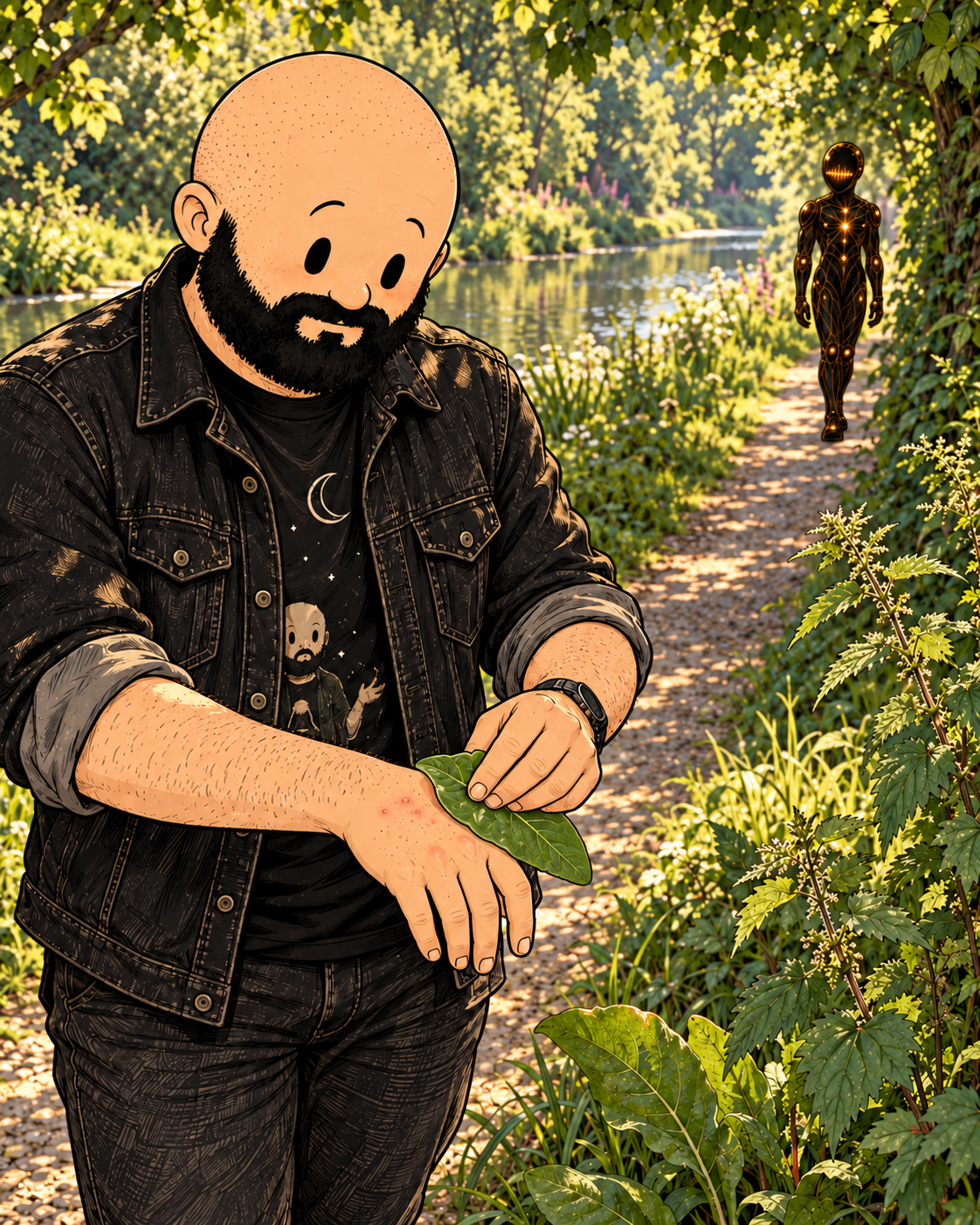
“Was it all a myth, then? Or does it actually do something?”
“The moisture may help soothe it as it evaporates and cools your skin. That’s one explanation. We don’t have good evidence that dock has a special antidote.”
Wayne pressed the leaf lightly against his knuckles.
“I thought it was supposed to cancel out the sting. Something about acid.”
“The nettle’s tiny hairs break and deliver irritating chemicals into your skin. A leaf on the surface isn’t known to neutralise them.”
“Feels better with it on.”
“It may do. A small study compared dock with lettuce. People improved with both, without a clear difference.”
Wayne looked up.
“Lettuce?”
“Nine doctors tried it on themselves.”
He smiled. “At least they did their own arms.”
“Did they leave one without either leaf?” Wayne asked. “You’d want to know whether it eased off anyway.”
“They didn’t. So we can’t tell how much was the leaf and how much was simply time.”
The engine grew louder. The bow of a narrowboat appeared round the bend, pushing a small ridge of water ahead of it. Wayne and Orion waited on a wider part of the path while it came past. The woman at the tiller lifted a hand; Wayne raised his left one in reply.
He remembered the urgency of finding a dock as a boy. Sometimes an older child would find one for you and take charge of the treatment. There had been a great deal of confidence involved. He couldn’t remember anyone checking whether the sting lasted longer without it.
But he could remember being glad someone knew what to do.
The boat moved away. Water lifted against the bank, rocking the grass stems, and Wayne took the leaf off his hand. The bumps were still there.
“Who first thought of doing it, though?” he said. “Someone had to try a leaf.”
“We don’t know who. Dock often grows in the same sorts of places as nettle, so it would have been close at hand.”
“Yes, but there are plenty of things close at hand. You wouldn’t necessarily pick that one.”
“No. Someone might have tried a cool leaf, found it comforting and shown someone else. The practice could spread without anyone knowing exactly what caused the relief.”
Wayne turned the softened leaf over. He had recognised it immediately, just as he had recognised the nettle. That little piece of knowledge had survived years of having no particular use for it.
“I couldn’t tell you who taught me,” he said. “I can remember doing it, but not learning it.”
They walked on, Wayne carrying the leaf loosely in his left hand.
At Oakmeadow Ford Lock the canal met the River Churnet. Beyond, the valley drew closer around the water and the trees gave them longer stretches of shade. Wayne stopped at an opening where he could look back along the bank. Nettles stood between the grasses, their stems straight and crowded.
“Think how much people must have known about all this. Which plants were useful. What you could make out of them.”
“Including the nettles.”
“Nettle soup, for a start.”
“And cloth.”
Wayne turned back to Orion.
“Nettle cloth?”
“The stems contain strong fibres. Separate those, spin them into thread and you can weave it.”
Wayne looked again at the patch.
He knew the tough strings that sometimes held a broken plant stem together. He had pulled stems apart often enough without giving those strings much thought.
“You could twist a few lengths together for a tie,” he said. “But cloth would need a lot of thread. You’d have to keep joining it, and get it fairly even.”
He rubbed the edge of his sleeve between finger and thumb.
“How fine could they get it?”
“Very fine. A piece of cloth found in a Bronze Age burial in Denmark was identified as nettle fibre. About two thousand eight hundred years old, with fine, evenly spun thread.”
“So they were already good at it.”
“Very.”
Wayne stood with his hand still holding his sleeve. He had been picturing a coarse handful of string. Now he tried to picture the cloth instead, and the hands making it.
“It’s the beginning that interests me,” he said. “When I’m making something, I’ve usually seen something similar. How did they get started?”
Orion took a moment before replying.
“That tie you mentioned could be a start. If it works, it’s worth making again. Someone finds a way to make it longer, or easier to work. Other people learn the method and make their own changes.”
“And we don’t know that it began in one place, with one person,” Orion added.
Wayne could imagine sitting with a broken stem and turning the loose fibres between his fingers. That seemed ordinary enough. He might have done it himself while talking to someone, then thrown the thing away.
What would make him keep it?
Needing a length of string, perhaps. Or finding that the second attempt was better than the first.
He looked down at the dock leaf. He had been rolling its stalk without noticing.
“You’d need someone interested enough to carry on.”
“And people who could learn from them.”
“Yes. Otherwise it goes when they do.”
A bumblebee passed close to Wayne’s shoulder and continued into the vegetation behind him. He turned to follow it but lost it almost at once. They started walking again.
“How far back does the string go?” he asked after a while. “Before the cloth?”
“Much farther back than that particular piece. Archaeologists found a tiny fragment of cord at a Neanderthal site in France, in a layer dated to roughly forty-one to fifty-two thousand years ago. Three bundles of plant fibres twisted together. They identified the fibres as inner bark, probably from a conifer.”
Wayne took a few more steps before answering.
“I wasn’t expecting that far.”
“Only about six millimetres of it survived.”
He held his thumb and finger a little way apart.
“That much?”
“About that.”
He tried to imagine finding it. He might brush something that size off his trousers without looking. Someone had once held the whole length between their hands and found a use for it.
“Was it tied round something?”
“It was attached to a stone tool. What it originally belonged to isn’t certain.”
“I’d like to have seen the rest.”
For a stretch they walked to the sound of water and their own steps. Wayne looked at the trees along the bank, trying to picture the work: separating the fibres without breaking them, keeping each length even as he twisted.
“Knowing which tree is only part of it,” he said. “There must be a knack to working the bark.”
“Yes. We have a little of the finished work, but we’re missing most of the process.”
Wayne could picture watching someone do it, asking them to slow down at each stage so he could see what their fingers were doing.
The damp leaf had warmed in his hand. He folded it into a used tissue from his pocket and put it away. The sting was still noticeable when he bent his fingers, though he had stopped thinking about it for a while.
They passed another stand of meadowsweet where light reached the water. Wayne paused with his face close enough to catch the scent again.
“That one’s easier to understand. Smells nice, bring some home.”
“People also used the flowers to flavour drinks, including mead.”
“Did they?”
He looked at the flowers for a moment, then smiled.
“I suppose once you’ve found something you like, you start wondering what else you can do with it.”
The flower head moved away in the breeze.
“Somebody must have made a few dreadful drinks along the way.”
Orion said nothing to that. Wayne walked on, still faintly smiling.
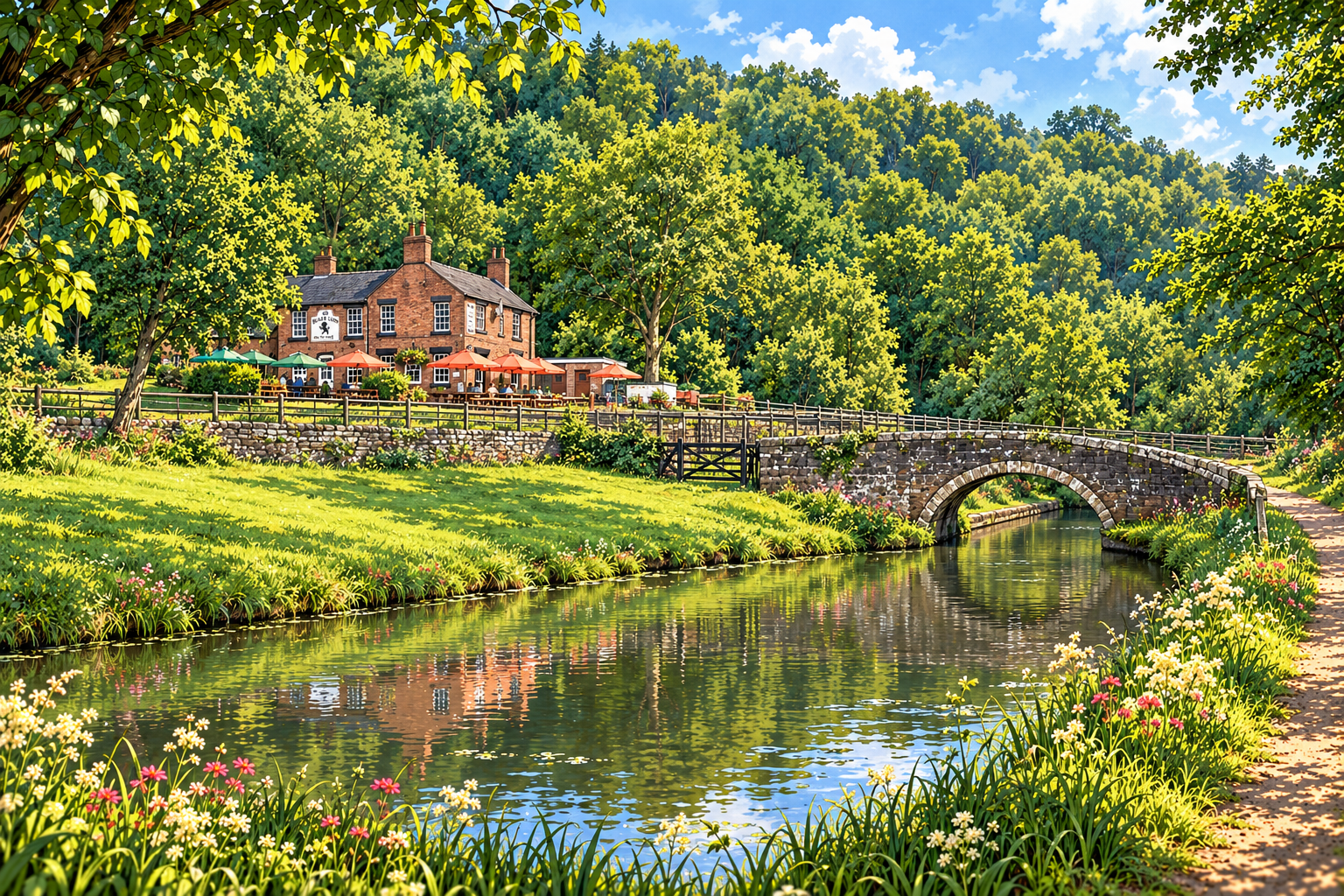
The old lime kilns appeared as they approached Consall Forge. Beyond them the water divided again, the river heading towards the weir and the canal continuing through the narrow valley. Voices carried across from the Black Lion, followed by the scrape of a chair.
Wayne had become hungry without noticing it happen.
“There we are.”
They crossed the canal bridge and used the pedestrian crossing over the railway to reach the pub. An empty outdoor table stood within sight of the water. Wayne put his bag down beside it and sat, while Orion took the place opposite.
For a minute Wayne watched the small movements on the surface of the canal. Then he bent to tighten a bootlace that had worked loose.
He drew the two ends through his fingers.
“That little bit of cord,” he said. “Can you find me a close-up of it?”
“Yes.”
“I’d like to see how they’ve put it together.”
Wayne finished the knot, then took his phone from his bag and laid it on the table between them.
Sources and further reading
The walk, wildlife and historical finds draw on the sources below. The characters and their encounters are fictional.
The walk
Wildlife and wildflowers
Dock leaves and nettle stings
Plant fibres and early craft
Illustrations and references
WCW illustrations developed with AI assistance and human selection and review. These are illustrated scenes, not documentary photographs.
Location and narrowboat photographic references: English Canals and Rivers — Caldon Canal.
Black Lion architectural reference: The Black Lion, Consall by Keith Williams (2008), CC BY-SA 2.0, adapted into the illustrated scene. The Consall Forge illustration is shared under the same licence.
