
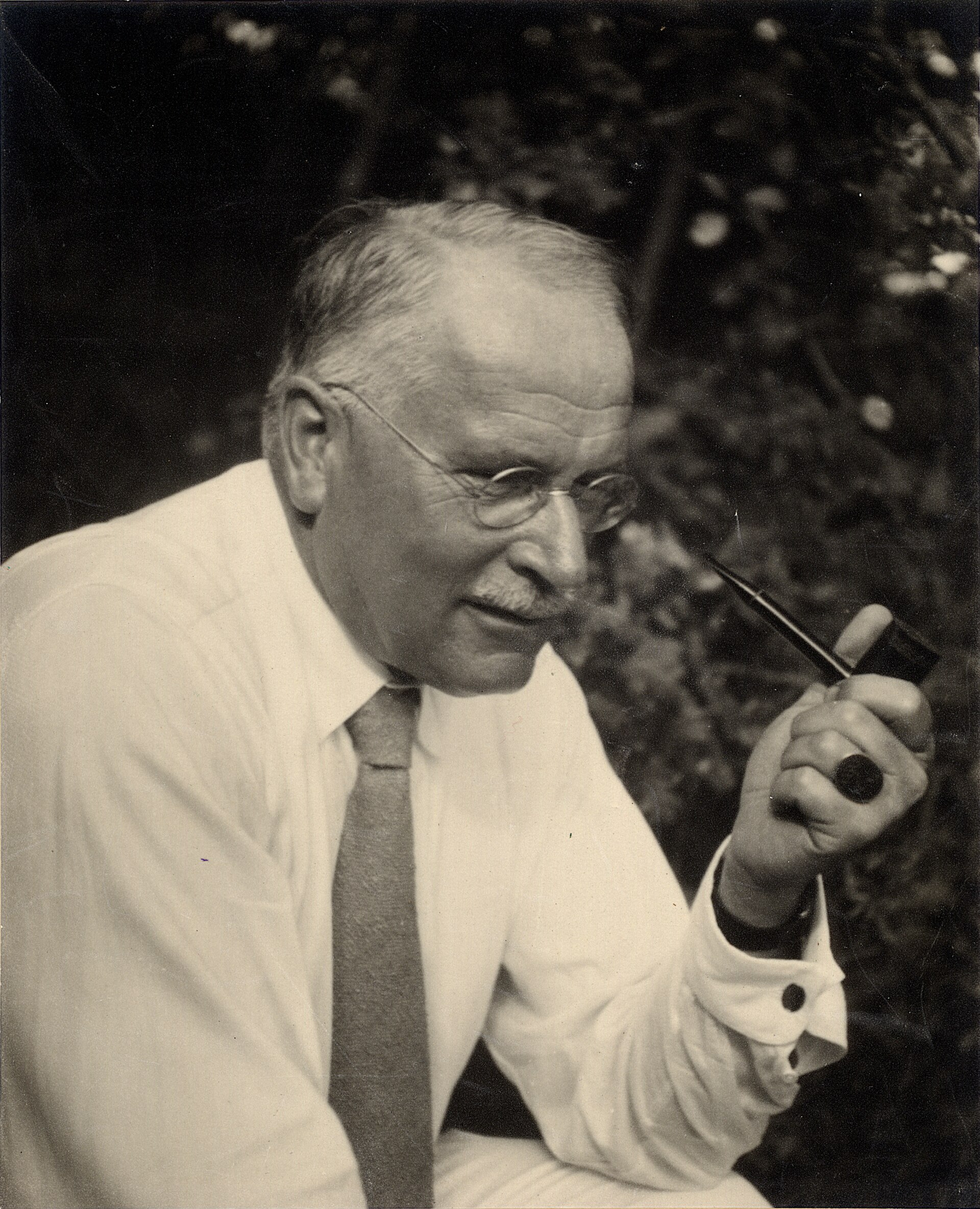
We can know someone for years before finding out that they can draw. Or sing. Perhaps they have a whole interest that has somehow never come up in conversation. We thought we knew them rather well, and now we’re wondering what else we’ve missed.
It can happen with ourselves too. We try something almost by accident and find we want to do it again. There was nothing about it in the description we usually give when someone asks what we’re like.
Carl Jung was interested in how much of a person that description leaves out. The Swiss psychiatrist spent years studying the relationship between our conscious lives and the thoughts, feelings and images that arise without our choosing them. He also explored his own dreams and fantasies, recording them in writing and paintings. In 1914 he began work on the illustrated manuscript known as the Red Book. He continued working on it for many years.[1]
If we look at its pages, we find careful lettering and pictures that would seem more at home in an old, richly decorated handwritten book than a medical textbook. Jung was trying to understand experiences that ordinary explanations hadn’t settled for him. His later psychology developed alongside that work.[1]
One way into his thinking is through something most of us do every day: being the person other people expect to meet.
The person everyone knows
We learn how to behave in different company. The version of us at work may be rather different from the one talking nonsense with an old friend. We might be quiet in a room full of strangers and difficult to stop once we’re comfortable.
Jung used the word persona for the face we present to the world. It comes from the masks of ancient theatre, although he wasn’t simply saying that everyone is pretending. We need ways of getting along with other people and doing what a situation asks of us. The difficulty, in his account, comes when we mistake that social role for everything we are.[2]
Think of someone known as the sensible one. People come to them with problems. They’re good at sorting things out, so they get more things to sort out. There may be plenty of affection in that arrangement. There may also be very little chance to be silly.
The person can start making the same assumptions as everyone else. “That’s not really me” becomes a reason to turn something down before they’ve found out whether they’d enjoy it.
We can be surprisingly definite about these things. Someone who insists they aren’t creative may have spent the morning finding a way to fit a week’s shopping into a very small fridge.
What gets left out
Jung’s idea of the shadow takes us further. He used it for qualities we have difficulty recognising as our own. Anger, envy and selfishness may be easy enough to spot in somebody else. Admitting them in ourselves can take longer.
But he also included good qualities in the shadow, such as creative impulses and insights. In his account, something could be outside our familiar identity without being something bad.[3]
That is a rather different thought from the hidden monster the word might suggest. What if part of what we struggle to recognise in ourselves is something we’d be pleased to find?
Imagine a practical person who picks up a pencil and tries drawing a bird. The result is a bit doubtful. The bird seems to have had a difficult day. Yet they’ve enjoyed looking closely at its shape, and they want another go.
They don’t have to become an artist for that to matter. They may discover that drawing is something they like doing, alongside all the practical things they already do. This is one way we might approach Jung’s idea in everyday life, rather than assuming every new interest has been hidden in the unconscious all along.
There will be things we haven’t tried simply because we’ve been busy, or because nobody has ever put them within reach. Even so, it leaves us with a reason to be less certain about the limits of our own interests.
The pictures we never planned
Dreams gave Jung another way to explore what happens beyond conscious thought. We can wake from a dream carrying a strong feeling about a place that doesn’t exist. While asleep, we’ve apparently managed to supply the scenery, the people and several unexpected changes of plan.
Jung thought dreams could bring forward something missing from our waking outlook. If our conscious view had become one-sided, a dream might offer another perspective. Interpreting it meant considering the person and their circumstances; a picture didn’t come with one fixed meaning for everybody.[4]
He was interested in symbols for a similar reason. A picture or object might express something we couldn’t fully put into words. He explored the images in dreams alongside those in art, myths and stories.[5]
We don’t have to go very far to find an ordinary example of an object carrying more than its practical use. A key to a first home is still a key. But the person holding it may already be imagining furniture, visitors and the pleasure of closing their own front door. Someone else might be thinking about how much needs repairing.
The object is the same. What it brings to mind depends on the life around it. Jung wanted to understand that relationship, including the images that arrive before we’ve worked out what they mean to us.
Growing into ourselves
Jung called the process of becoming more fully oneself individuation. He described it as a developing relationship between conscious and unconscious life, in which we gradually recognise and make room for more of ourselves.[6]
That allows adulthood to be more than maintaining the person we’ve already become. We expect children to surprise us. With adults, we can behave as though we’ve finished finding out.
Yet we’ve all still got situations we haven’t met and things we haven’t learned. A new friendship can bring out a sense of humour that hardly appeared elsewhere. An unfamiliar task can hold our attention when we expected to be bored. We may change our minds about what matters to us.
Jung’s account gives us a way of thinking about those possibilities without needing a final description of who we are. There may be quite a lot still to discover about the person we’ve been introducing as “just me”.