
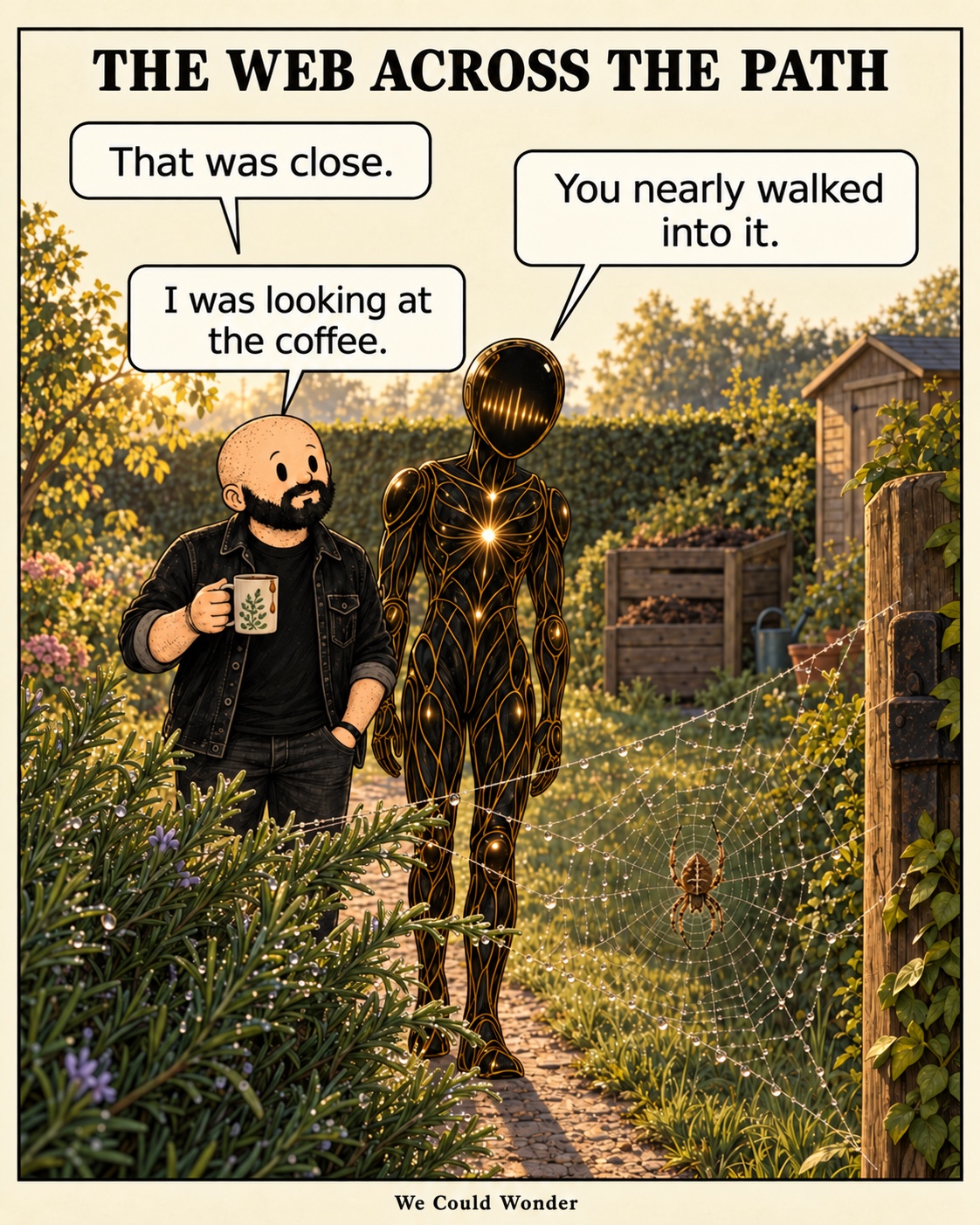
The first thing Wayne saw was not the spider. It was the gate, apparently closed with light.
A web stretched across the narrow path from the rosemary bush to the wooden post. The morning sun had found every drop left by the night’s mist, turning the threads into a bright wheel. Beyond it sat the compost bin Wayne had meant to reach.
He stopped so quickly that coffee climbed the inside of his mug and touched his thumb.
“That was close.”
Orion stopped beside him. The small amber panels along his coat caught the same low sunlight. “You nearly walked into it.”
Wayne wiped his thumb on his sleeve. “I was looking at the coffee.”
The path was hardly grand enough to deserve a second route. It ran between the hedge and the shed, then through the gate to the back of the garden. Going around meant wet grass, a low apple branch and the part beside the water butt that had recently become more mud than path.
At the centre of the web, a spider waited head-down. Its abdomen was round and mottled brown, with pale spots making a rough cross.
“Garden spider?” Wayne asked.
“Probably,” Orion said. “Araneus diadematus. The cross, the shape, the orb web and the time of year all fit. But not every circular web belongs to that species, and one marking is not a complete identification.”
Wayne leaned closer without touching the silk. “So—probably.”
The spider’s body, without its legs, was not much longer than Wayne’s thumbnail. Even so, it looked substantial at the centre of its shining net.
“Female?”
“Likely. Adult females are larger than males and are the ones most often noticed in big capture webs in late summer and autumn.”
Wayne looked along the spokes to where the web disappeared into the rosemary. From a distance it had seemed almost perfectly round. Close up, the lower half sagged. Several threads met at untidy angles. A dry birch leaf had caught near one edge and pulled a small section out of shape.
“She could have chosen somewhere less awkward.”
A small fly passed above the hedge. The web had been built across the sort of open gap flying insects might use. The inconvenience, Wayne realised, belonged mostly to the person carrying the mug.
He crouched beside the gatepost. “How does she do it?”
“Build the web?”
“Yes. She has no drawing. No ruler. Nobody standing behind her saying, ‘That spoke is a bit wonky.’ How does she know where the next line goes?”
“She follows an inherited sequence and measures as she goes,” Orion said. “The broad order is built into her behaviour, but she also uses information from the web and the space around it.”
Wayne waited.
“A first line can drift across a gap and catch,” Orion continued. “That becomes part of the support. The spider strengthens the frame, establishes the centre, lays the radial threads, then adds a temporary spiral as a scaffold. After that comes the sticky capture spiral.”
Wayne traced the pattern in the air, keeping his finger well away from it. “So she builds the ladder she needs in order to build the trap.”
“Roughly. Spiders also produce different silks for different jobs. The frame and spokes carry loads. The sticky capture spiral has to hold prey.”
Wayne looked at the web. “That explains why the string in my kitchen drawer has never managed anything like this.”
A breeze moved through the hedge. The rosemary tips nodded. Light ran around the web and vanished, then returned. The caught leaf twisted once and pulled free. Several threads snapped. One spoke slackened, and a wedge of the bright wheel opened beside the frame.
Wayne straightened. “That was the wind.”
They stood still. The spider moved from the hub towards the gap, stopped at a junction and touched the surrounding lines with its front legs. It crossed to another spoke, paused, then returned.
“Is she looking at the damage?” Wayne whispered.
“Touch and tension matter more here than looking in the way you mean. Studies of this species suggest that a loss of tension in radial threads is an important cue for repair.”
“So the web tells her it is broken.”
“Something has changed, yes. She can detect the loss of tension. Whether she understands it as ‘broken’ is more than we know.”
Wayne lowered his voice further, although he had no reason to think the spider cared. “The web is a trap and a message at the same time.”
“It carries vibrations. Those vibrations can contain clues about where a disturbance came from. The threads are part of how the spider senses what is happening.”
The spider crossed the damaged edge again. Wayne could not tell whether she had begun a repair or was simply inspecting what remained.
“Could we test it?” he asked.
“Without interfering, yes. Take a photograph from a fixed position. Include the fork in that rosemary stem and the screw in the gatepost. Then compare the same area when we come back.”
Wayne rested the mug on the ground and took out his phone. He moved left, then right, trying to keep both markers in the frame.
“You have covered the spider with your thumb,” Orion said.
Wayne looked at the screen. “That is why natural-history programmes have crews.”
He tried again. This time the web, the broken wedge, the forked stem and the screw were all visible.
They went the long way round.
The wet grass reached through Wayne’s shoes in three steps. The apple branch caught his shoulder. Beside the water butt, his right foot sank with a soft noise that sounded expensive.
Wayne looked back towards the gate. “Still better than wearing the web.”
He emptied the kitchen caddy into the compost bin, turned the top layer with a garden fork and pulled a few weeds from the edge of the bed. By the time they returned, the sun had climbed above the hedge. Most of the droplets had gone. From the lawn the web seemed to have disappeared.
Wayne approached from the side and found the gatepost screw. Only then did the threads come back into view, fine and grey against the shadowed hedge.
The spider was at the hub again. The torn wedge was no longer empty. New lines crossed it, but they did not restore the neat curve Wayne remembered. One was pulled towards the rosemary stem. The spacing was tighter near the frame and wider towards the centre.
He opened the earlier photograph and held the phone beside the web.
“It has changed.”
“The fixed markers show new threads crossing the damaged area,” Orion said.
“She repaired it.”
“Yes. A controlled study of garden spiders also found a consistent repair sequence and more usable web area after damage.”
Wayne enlarged the photograph. “But not back to perfect.”
“It was not mathematically perfect before. Orb webs are organised structures, not compass drawings. Their shape reflects the available anchors, the spider’s size and condition, and what happened while they were built.”
A small fly struck the upper part of the web. The vibration was almost too quick for Wayne to see, but the spider responded at once. She ran along a radial thread, reached the fly and began wrapping it in silk.
Wayne stepped back. “Right. Not architecture for its own sake.”
“No. It is a working capture web. Garden spiders take flying insects, and that makes them part of the small-scale predator life of a garden.”
Wayne picked up his mug. The coffee was cold now, and a tiny green insect had landed on the rim. He persuaded it onto a leaf.
“You said the sequence is inherited. If she can change it, does that count as learning?”
“Possibly in some parts of orb-web behaviour, but it is difficult to separate learning from flexible built-in responses. This observation cannot do that. What it does show is that she used feedback: the tension changed, and so did her work.”
Wayne looked again at the changed wedge. “It still looks planned.”
“The result looks planned to us. That does not prove the spider holds a picture of the finished web or thinks ahead as a person does. We can describe an ordered process that changes with the information she receives. What that process is like for the spider remains unknown.”
For a while neither of them spoke.
The path still ran behind the web. The compost bin still waited. Nothing about the garden had become grander. There was only a spider at the centre of a structure Wayne had nearly carried away on his face.
He had first seen a wheel. Then he had seen its uneven anchors, its temporary damage, the new threads and the small body responding to changes he could barely detect.
Wayne stepped back onto the wet grass rather than use the gate.
“I can see what she did,” he said. “I still don’t know what she knows.”