
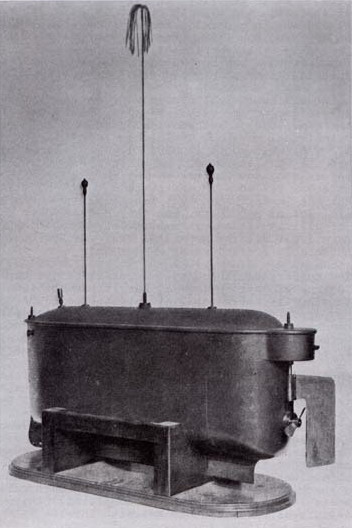
A small boat that turns when someone presses a control would be an ordinary enough toy now. In 1898, Nikola Tesla demonstrated one at Madison Square Garden in New York. He was controlling it by radio, without a cable joining him to the boat. [1]
It’s easy to read past that because we already know remote control works. We use invisible signals so often that we’re usually only interested when something stops responding. But Tesla had built a vessel that could receive an instruction across the water and act on it, more than a century ago.
The boat carried its own battery and machinery. The radio signal told the mechanism what to do; it wasn’t supplying the power to drive the boat. Tesla’s patent described arrangements for controlling its steering and propulsion from a distance. [2]
Once that was working, there was plenty else to think about. Could an unmanned vessel carry instruments somewhere difficult to reach? Could it transport supplies? Both possibilities appeared in the patent. Tesla also considered military uses. [2]
We can recognise versions of those questions in machines around us now. A person can send instructions to equipment somewhere they cannot easily go themselves. Reading about the boat makes us wonder how Tesla arrived at it, and what an invention looked like to him before there was anything to demonstrate.
Building it in his head
In his 1919 autobiographical essays, My Inventions, Tesla described working on machines in his imagination. He said he could alter a design, watch it operate mentally and even notice whether it was out of balance before building it. [5]
We have his description of that experience, written later in his life. We can’t look inside it ourselves. But it tells us how much of his work he believed he could do before picking up a tool.
Many of us will recognise something smaller in that. We picture how a shelf will fit, or turn a piece of furniture around in our minds before attempting it in a narrow hallway. Sometimes the real furniture has other ideas.
The useful part is being able to consider an arrangement that doesn’t yet exist. We can change it without first making every version. Tesla described taking that much further, using his knowledge of machinery to imagine moving parts and how they would behave together. [5]
His engineering gives us something we can inspect as well. Ten years before the boat demonstration, he had presented a system of alternating-current motors and transformers to the American Institute of Electrical Engineers. [3]
Inside the motor was an idea that takes a little getting used to, even when someone explains it.
Making a magnetic field turn
An electric current can produce a magnetic field. Tesla arranged coils around a motor and supplied them with currents that varied in a coordinated sequence. The coils stayed where they were, but their combined magnetic field rotated. [6]
We can get part of the picture by thinking about a wave moving around a stadium. Each spectator stands and sits near their own seat. The wave travels around the ground without everybody having to run after it. The physics in a motor is different, but the example helps separate a moving pattern from the movement of the things producing it.
In an induction motor, the changing magnetic field produces currents in the rotor, the part inside that can turn. Their magnetic interaction supplies the turning force. Electrical energy becomes mechanical movement. [3]
We usually meet a motor through whatever it is doing for us. We want a machine to run. We may never need to think about the arrangement of currents that makes it possible. Yet somebody had to work out how to produce that motion, then make equipment that could use it.
George Westinghouse licensed Tesla’s motor patents in 1888. The Henry Ford museum holds a Westinghouse induction motor exhibited at the 1893 World’s Columbian Exposition. Motors helped make alternating-current systems useful for more than lighting. [4]
Tesla’s lecture describes different arrangements and observations as he explains his work. There is plenty of detail beneath the familiar picture of an inventor having a sudden idea. [3] He had machinery to understand, people to explain it to and designs that others would go on to manufacture.
That gives us more to think about than a story of someone simply being born a genius. What he knew about electricity gave him things to work with in his imagination. He could consider possibilities that would not occur to someone who had never encountered those principles.
What else could we make
We see that connection between knowledge and imagination in more familiar work too. Someone who knows plants can picture how a garden will change through the seasons. A musician can hear possibilities in a few notes. Learning how something behaves gives us more ways to imagine changing it.
There is room for people to meet across those interests as well. A person who understands the machinery may not be the one who notices a new use for it. The person who needs a job doing may have no idea that a suitable mechanism already exists.
We can follow that thought back to Tesla’s boat. Steering a model across a pool was something he could demonstrate. The uses he described went beyond the pool, into places where sending a person might be difficult or dangerous. [2] He was already considering what else the mechanism might do.
That doesn’t mean every later remotely controlled machine came directly from this one boat. Plenty of people and further inventions were involved. But we can still look at the demonstration and recognise an idea that has become part of everyday life: a machine responding to someone who is somewhere else.
It makes the things we now take for granted feel a little less ordinary. We live among other people’s answers to problems, including problems that once looked very difficult to solve.
Somewhere there will be an awkward model on a workbench that we wouldn’t know what to make of yet. Perhaps, years from now, somebody will be complaining because the finished version takes an extra second to work.